Unknown's avatar

Posts by Deb Burdick

Ghostwriter and content coach Deb Burdick helps her authors identify their reader, capture their message, and polish their written voice in order to achieve their writing goals. Whether working as a coach or a ‘full ghost,’ Deb infuses magic into something that feels like work to many people: clear, effective written communication that sounds like the author at their very best. As one half of a museum exhibit design partnership, Deb has navigated the ever-changing business landscape of subject research, budgets and schedules, concept presentations, and exhibit installation. If you want to know the stories behind the stuff, ask Deb. She thrives on continually challenging the creative process and maintaining exceptional client relationships. Flexible, good-humored, and quick to connect with others, Deb lives in Wolverine, Michigan. She and her artist husband have two grown daughters.

The Touchstone of Courage

Asking for courage is like asking for faith, or patience – you don’t get a magical infusion of the thing. You get opportunities to develop it.

“I wanted you to see what real courage is, instead of getting the idea that courage is a man with a gun in his hand.  It’s when you know you’re licked before you begin but you begin anyway and you see it through no matter what.  You rarely win, but sometimes you do.”  ~ Harper Lee, To Kill a Mockingbird

I think maybe, just maybe, courage is determination wrapped up in persistence. Courage is not knowing the outcome, or knowing the odds are not in your favor, and trying anyway. It’s facing an unknown, unsettling, hard, scary, sometimes even dreadful thing. Taking its measure. Refusing to be defined by it. Formulating a plan. Stepping out. Seeing progress, which feeds more progress. Getting that sense of having turned a corner, and feeling the euphoric rush of certainty that you will see it through.

Courage is a touchstone.

“Courage is not simply one of the virtues, but the form of every virtue at the testing point.” ~ C.S. Lewis

What is a touchstone? It’s a test for determining quality, authenticity, or genuineness. Why does this matter? It means this: the source of our greatest fear can become the touchstone for our greatest courage.

A tangible reminder of my days with Cheryl.

A tangible reminder of my days with Cheryl.

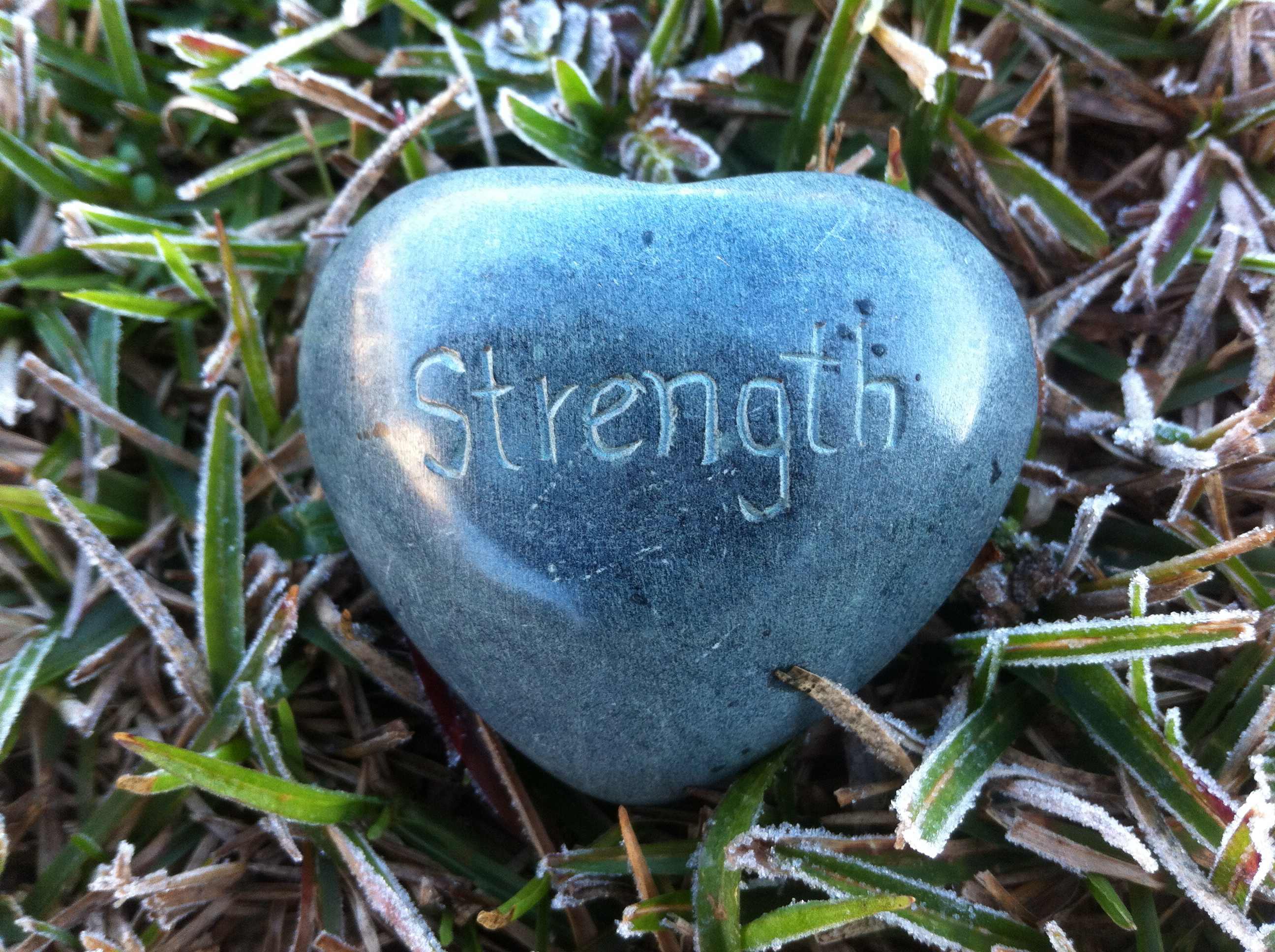
I have a touchstone. It is a heart-shaped stone, polished and etched with a single word: STRENGTH. I carried it with me a few years ago when I traveled to Tallahassee on weekends to spend time with my beloved cousin Cheryl when her breast cancer, five years in remission, spread to her bones. It was a journey she did not want to take, because in going toward her future, she had to step away from the people and the life she loved wholeheartedly. Choosing to do that, to accompany her in that intimate way, as her physical health failed and her faith shuddered and groaned, was at once the hardest and easiest choice ever. How do I do this? Better to ask, how do I not? She taught us so much in her suffering: how to be graceful, eloquent, and concerned with the well-being of others, always. How to let herself be loved and reassured and cherished. And how to love and reassure and cherish those of us who gathered around to accompany her on that private, noble journey. It was a time of continually giving and receiving permission to let go and accept the reality of what was happening not just in Cheryl, but through her in us. It was an exquisitely sweet time, one in which our world became very small as we sat with her, and held her, and cried with her, and reminisced and laughed and knitted our very souls together in one comforting blanket of love and memories. The stone still represents the strength she both gave and received.

“It takes a lot of courage to release the familiar and seemingly secure, to embrace the new. But there is no real security in what is no longer meaningful. There is more security in the adventurous and exciting, for in movement there is life, and in change there is power.” ~ Alan Cohen

What are we most afraid of? I believe it is precisely that place that will be the source of our courage. And encouragement? To me, it’s sharing our courage with others who need it. Stepping into their journey with them. Sitting with them in their storm. See, when we ENCOURAGE someone, we are actually infusing them with courage they can’t generate within themselves. They are on the inside of the storm looking out and feeling overwhelmed. We are on the outside of the storm looking in, and we see its limits. We are seeing beyond their storm. What a gift.

For more on the subject of courage, and encouragement, please visit: http://www.incourage.me/

Beach House Bones

A few years ago, when my husband was working with a real estate investor, one of the properties he was tasked with rehabbing was a hurricane-ravaged beach house at Fort Morgan, Alabama. It was listed for sale at about a million and a half dollars. This house would have made a fabulous bed and breakfast; built on tall pilings to raise it above potential floodwaters, it had three bedrooms with private baths upstairs, two bedrooms with an adjoining bath downstairs, and a huge open kitchen, great room, and dining area with soaring cathedral ceilings. A wide, sweeping stairway graced the front of the house. At the back of the house, a wall of French doors topped with tall transom windows opened onto a wide, weathered deck overlooking Mobile Bay. With all the doors and windows open, whether the breeze was from the south off the Gulf of Mexico or from the north off Mobile Bay, there was always a sea breeze stirring.

We stayed there right after the contractors had finished replacing drywall and rehabbing bathrooms, cleaning the house thoroughly over the course of several days. The first night we all slept on air mattresses in the great room. Even when everything was closed up, we could hear the muted roar of waves crashing on the Gulf of Mexico shoreline. We were on the opposite side of the narrow strip of barrier island, overlooking Mobile Bay, which was calm by comparison. We scrubbed dried salt spray from the window exteriors, polished about a mile of hardwood floors, scoured recently renovated bathrooms and swabbed the kitchen cabinets and appliances, inside and out. The pleasant scent of Murphy’s Oil Soap mingled with the fresh salt air. It felt a little like primitive camping in a luxury condo with great “bones” but no luxury accessories. If we wanted towels and toiletries in the bathrooms, we had to bring them ourselves. Ditto for mints on the pillows….and the pillows!

In the evenings we ventured out to a small market nearby to buy fresh seafood, bread, milk, and ice cream. Simple meals allowed us maximum time outside on the water or exploring the grounds. At one time the landscaping must have been beautiful, but everything had gotten overgrown while the house stood empty. Trimming back big ligustrum and azalea shrubs, we discovered stone patios, benches, and tables and chairs hidden beneath low-hanging branches. In the front bedroom, the arms of an ancient, twisted live oak tree reached up past the windows, making the room feel like a treehouse. Another bedroom, the girls’ favorite, had a cozy window seat with hidden storage cubbies underneath. The large master bedroom was warmed by a double-sided fireplace and opened directly onto the deck overlooking the bay. The master bath seemed huge and endless, with a beautifully tiled, walk-in shower that was big enough for entertaining and a bathtub the size of a hot tub.

From time to time, a great blue heron would appear at the edge of the bay, wading along the shoreline in the shallow water. My daughter Marley promptly named him “Carl.” He was alone, and seemed unable or unwilling to gather food for himself. One evening after we’d peeled a pound of shrimp, we took the uncooked trimmings outside and tossed a few in Carl’s direction. He was timid at first, but eventually came close enough to retrieve the shells and tails floating on the water. A neighbor saw us doing this, and I was concerned we were doing something wrong. She said no, it was okay, the heron had been injured at some point years before and he had trouble finding his own food. She, too, fed him on a daily basis, and he seemed to expect it now.

What I remember best about that time is the simple, unstructured way the days and nights fell into place. We had no real agenda or schedule, other than getting the house clean and minimally furnished. We ate when we were hungry, worked while we had energy and tasks ahead of us, slept when we were tired, and it was enough. Restorative. Satisfying.

Slingshots and Indelible Reminders

We are a slingshot family these days. Imagine a map of the United States. Picture a point in the farthest reaches of the Pacific Northwest. That’s my daughter and son-in-law up there, in country once explored by Lewis & Clark, with its misty forests, soaring mountains, and legendary traffic. Then picture a second point way up in the northeast along the Atlantic coast. That’s my other daughter and my husband, the Grass Master and the Great One, collaborating with a team of talented creatives to bring the world’s largest outdoor retail experience indoors.

If that’s the “sling,” that leaves me, the “shot,” down here perched on the sandy shores of the Gulf of Mexico, almost as far west in Florida as a body can physically go without crossing into Alabama. And there we are, scattered across three time zones, almost 2500 miles from east to west. I’m 2700 miles from one part of my family and 1200 miles from the other.

But instead of moaning about how far apart we are, I prefer to dwell on how close we are despite the miles and time zones between us. Thanks to the wizardry of technology, we can text, FaceTime, Skype, instant message, e-mail, or (sometimes) call any time we are so inclined. I can set up a CopperCam so my daughter can see her beloved Golden Retriever. I can watch her make a fabulous dinner. I can’t take her to the mailbox due to the limitations of wi-fi, but who wants to make a family outing to the mailbox anyway?

An airman escorting the body of a fallen hero stands at attention.

Earlier this week as part of our family journeyed northeast after a visit home, they snapped an airport photo (above).

At first glance, it looks like a scene you see every single day, at airports everywhere. Plane at gate. Luggage carts. Supply and fuel carts. Jetway in place. Check, check, check.

But look closer. Look at the nose of the plane, and then look to its left, on the runway, on the ground itself. See him? Standing there? A lone airman, standing at attention. Waiting to render honors as a yet-unseen flag-draped casket slowly rolls by.

And suddenly you realize what is unfolding in front of you. With no fanfare whatsoever, you understand that this man is escorting a hero home to his or her final resting place. And the background noise of a busy airport fades away, and the silence inside you grows into something large and almost tangible. You are on your feet, at the window, hand over your heart, tears in your eyes, grieving the loss of someone you never got the chance to know, honoring their service and their sacrifice.

At the end of most flights, people wait impatiently, eager to welcome friends and family at the end of a journey home. At the end of this flight, passengers waited while the airman escort disembarked first, to respectful applause. And at the end of this trip, a grieving family waited with a peculiar mixture of dread and anticipation to welcome home a beloved family member who gave their life for their country.

If you haven’t seen it, I highly, highly recommend watching the movie “Taking Chance.” Based on a journal kept by Lt Col. Michael Strobl as he escorted PFC Chance Phelps to his home in Wyoming, it is a powerful, compelling tribute to our fallen heroes and their journey home.

I especially like this journal excerpt: “The Marine Corps is a special fraternity. There are moments when we are reminded of this. Interestingly, those moments don’t always happen at awards ceremonies or in dress blues at Birthday Balls. I have found, rather, that they occur at unexpected times and places: next to a loaded moving van at Camp Lejeune’s base housing, in a dirty CP tent in northern Saudi Arabia, and in a smoky VFW post in western Wyoming.” And, I might add, on a hot, humid day beneath towering thunderheads in Pensacola, Florida.

Watching the airman today, I am sure that the Air Force is an equally special fraternity. Today’s snapshot is one of those indelible reminders.

Summer Evenings in Old Seville Square

During the summer, weekends don’t begin on Friday – they arrive casually escorted on the arm of Thursday evening, as thousands gather in downtown Pensacola’s Seville Square to eat, visit, and enjoy open-air concerts. “Evenings in Olde Seville,” a free concert series that began in 1987, features local talent ranging from bagpipes and bluegrass to big band and beyond. The setting is unmatched – towering heritage oaks spread their broad, Spanish moss-laced branches over the park, once a parade ground for British and Spanish military troops. Historic structures like Old Christ Church and the exquisitely preserved Dorr House and charming eateries with names like Hub Stacey’s, Dharma Blue and Moreno Café surround the square. Each week there’s a drawing for a dinner prepared and served in the square by a local restaurant.

The real magic happens as the sun sets. Street lights and stars begin to twinkle through the massive tree canopy. A patient horse pulls a carriage filled with beaming riders around the park’s perimeter, the sound of its hooves echoing on the pavement. The music entices dancers of all ages to take to the brick pavilion near the park’s gazebo. An occasional breeze off the bay carries the scent of magnolia blossoms, citronella candles and the delicious fragrance of the nicest picnic dinners anywhere. Beer and wine flow freely, and as the evening progresses, everyone loosens up.

Some people make quite an occasion of the evenings. They arrive early to secure favored spots, circling lawn chairs around folding tables, sinking citronella torches into the ground, and clustering bright balloons or maybe a colorful pennant as a landmark for their location. I’ve seen snowy white linen tablecloths and napkins, crystal wine goblets, fat candles in glass hurricane globes, and tableware that’s “the real thing” – no paper or plastic in sight. Someone has spent hours planning and preparing a meal that’s able to be transported and served outside, and eaten almost exclusively with one’s fingers while standing and mingling with others – typically it’s a mouth-watering selection of “little bites,” tortilla wraps filled and sliced thin, crackers and minty cucumber dip, fruit and vegetable platters, two-bite sugar cookies, and impressive mounds of freshly boiled Royal Red shrimp on ice.

And I’ve seen people just show up, nothing at all in their hands, drawn to the music and the atmosphere like moths to a flame. They’re the ones whose faces are alight with the discovery of this event tucked into a pocket of downtown Pensacola. “And you do this every Thursday night?” they ask. Just one of the perks of life in Pensacola during the long, hot summers.

Celebrating our Nation’s Independence, Pensacola Style

Each Fourth of July, we’d make a patriotic pilgrimage…we’d load the old Red Flyer wagon with collapsible lawn chairs and the ever-present wood slat-topped table, a favorite old porch quilt for sitting or sprawling on, a cooler filled with ice and popsicles and sodas, and summertime snacks like sliced watermelon, cucumber sandwiches, thick, crunchy Zapp’s potato chips and cakelike sugar cookies slathered with creamy icing and sprinkles. Time was, when the kids were small, we’d outfit ourselves in newly acquired Old Navy patriotic tee shirts purchased just for the occasion.

Arriving downtown while it was still daylight, we’d trudge through the Gulf Power parking lot past the Wall South Vietnam memorial to a spot along Bayfront Parkway where we were sure to have a good view of the fireworks overhead. Police closed off the road in both directions. Thanks to the dry weather, personal fireworks were banned, but little flameless “poppers” still punctuated the heavy, humid air.

We’d spread the quilt on the grassy median and stake out our territory with lawn chairs. Frisbees were tossed back and forth and we settled in for several hours of the finest people watching anywhere. Occasionally we spotted familiar faces in the gathering crowd, and our numbers swelled as friends joined us.

Darkness settled, and as nine o’clock approached, radios around the park tuned in to stations broadcasting the patriotic music that accompanied the fireworks. A few tentative test rockets were launched, their bright flash and loud “boom” echoing across the calm waters. Children flinched and clutched their ears tightly. A glance across Pensacola Bay revealed the pretty sight of lights sparkling on dozens of boats gathered for the show.

The music and the first “real” fireworks launched simultaneously, and for thirty minutes we were entranced by the impressive light show high over the bay. Every one seemed larger than the last. A thin haze of gray smoke drifted on the almost-nonexistent sea breeze.

A thunderous, spectacular finale signaled the end of another successful show. Applause broke out and a chorus of horns sounded from the boats on the bay. We lingered, in no hurry to join the traffic gridlock accompanying this holiday. After about an hour, when the police informed us they were ready to reopen the road, we gathered our belongings, reloaded the wagon, and headed back toward our cars. Just before midnight we were home, tired and satisfied, another successful celebration of our nation’s birth. Ironic, wasn’t it, that a nation born through conflict and struggle and determination would celebrate with some of the same sights and sounds generations later. A reminder of our beginnings, perhaps.

Empty Nests and Full Hearts

I jotted these thoughts a while ago while watching a mama mourning dove raising her babies. Sent them to a friend wrestling with the reality of her kids leaving the nest.

I watched a mama mourning dove raise a baby just outside my kitchen window this spring. I discovered her by accident when I went to plant flowers in a hanging basket and off she fluttered! I peeked at the eggs, smiled, and planted those flowers elsewhere. For the next several weeks I watched that peaceful little gray mama shelter those eggs, sitting still, rocking slightly in the breeze, enduring sun and rain and me looking out the window at her sometimes. We made eye contact. (Yes I know it’s a bird. But still.) I thought of her a lot. A few weeks later I saw the funniest looking little gray baby poking its beak out of that nest! The mama was extra vigilant then and I kept my cat away from the back yard. Just in case.

That baby grew fast! In just a few weeks it was too big for the mama to sit on any more. They just snuggled close together and I liked that a whole lot. It was sweet to watch. And then yesterday morning I heard cooing and fluttering, and when I looked out the window, the nest was empty. No mama. No baby. Not on the ground, not nearby, just gone.

I wonder if the mama looks back on those days in her cozy little nest wistfully. Not sure if birds have the ability to remember and reflect. For sure she did her job well, and now it’s on to the next thing. She’s not moping around the nest. I haven’t seen her. Probably she’s somewhere getting a pedicure and eating a worm souffle, I don’t know.

Even in the craziness of family life, and I’m sure you know this, there is a normalcy, a cadence, and right now, that’s missing. Nothing feels normal at the moment except this notion that more change is on the horizon. And you know what? That is okay. We can adapt to pretty much anything. Our growing/grown kids have shaped and made us, even though the void left by their absence is, initially, huge. Alone, after all those years of togetherness…is that supposed to be a goal? My daughter has suggested I foster dogs. I would be the woman walking around the neighborhood with crazy hair and fifteen dogs on leashes. Not letting any of them leave. No, I think that’s not my best bet.

So I don’t have all the answers, or even many answers…but I can tell you, you’re not alone in grappling with this transition. Don’t lose your sense of humor. And I’ve seen your family photos. You HAVE to have that. Any family as close as yours, or mine, has shared experiences that can cause laughter to erupt without warning. And now, at the moment, tears. So hang in there, my friend, and keep smiling.

I was working on a project site today and met six of the sharpest young sailors in the fleet. They were part of a working party and OH BY THE WAY if you ever need to get anything done, you call on a Navy working party, and there is nothing you can’t do with their help! Anyway I enjoyed meeting them, and talking with them, and they were delighted to just have somebody talk to them that wasn’t trying to sell them something at a mall kiosk. I thought of all the Navy sons and daughters I’ve known and loved through the years, and how reassuring it is to know that our country is in such good and capable and energetic hands. And I thought, I don’t wish them back here. They are doing what they trained to do. They’re ready. They’re strong. And it’s time.

Issues and Bear Hunts

I read an essay by a favorite writer this week (Joseph Epstein) in which he delved into words and their meanings. Three words, in particular. It was one of those things I read, and read again, and thought about, and kept thinking about.

The words? Pretty simple. Issue. Question. Problem. We use them all pretty freely. Especially “issue.” Wow, do we love that word. Everybody has an issue with something. It’s a fairly safe word. There’s just not a whole lot of accountability there. You can’t argue with the statement, “I have issues with…” Whatever. Big hairy spiders. Fried food. Thunderstorms. Inconsiderate neighbors who party in their pool at all hours like they are the only people on the planet.

It is possible that we have somewhat overused the word “issue” in our modern vernacular. And the danger in doing that is when a word can be such a gigantic blue tarp covering all manner of situations and conditions, it can lose its original intended use and meaning. As Epstein says, “A happy vagueness resides in the loose use of the word issue.

What’s the difference between an issue, a question, and a problem? Aren’t those words reasonably interchangeable? Can’t we have, say, hair issues, hair questions, and hair problems?

Of course! But I love how Epstein, while working as senior editor at Encyclopaedia Brittanica, learned the distinctions between those three words from HIS chief, Mortimer Adler: “A problem calls for a solution, a question for an answer, and an issue is something in the flux of controversy.”

How much more clear does it get? It seems like it’s so easy to use the word “issue” to cover a host of subjects precisely because it requires no action. It’s fairly innocuous. It doesn’t demand an answer or a solution. It just IS.

So if, when we assume, we make asses out of you and me (c’mon, that’s how teachers taught people to spell ‘assume’ when I was in school), what do issues make? Isses? Out of you and…well…us? It’s not very elegant. But maybe issues just make IS-es that hover around wringing their little soft hands, muttering quietly, getting underfoot, and interfering with progress. We can’t resolve them. We can’t get around them. We can’t dismiss them. What do we do with them?

When my daughters were little, they adored the book Going on a Bear Hunt by Michael Rosen and Helen Oxenbury. Relished it. Asked for it nightly. Word to the wise: This. Is. Not. A. Bedtime. Story. Why not? Well, because despite its lovely illustrations and lilting storyline and deceptively small size, it is an action book. It draws you in. The bear hunt demands action. It just does. And the best person I know to read the bear hunt story is my mother’s oldest younger brother Dan, who absolutely nails the cadence and drama of the story and leaves streams of hysterical kids in his wake like a comet, none of whom are remotely ready for bed. But I digress.

When we go on a bear hunt, we encounter all kinds of things. Gates. Mountains. Giant fields of wavy grass. Rivers. Caves. And eventually…the bear itself! Likewise, when we go on an “issue hunt,” we encounter all kinds of things. Mostly giant question marks. The main one being, is this really an issue? Or, based on Epstein’s definitions above, is it a problem that has a solution, or a question that has an answer? And, like the bear hunt, the only way to resolve that question isn’t to waffle around in definitional limbo. (You know you like that phrase. Feel free to use it somewhere. It’s on the house.) You can’t go over, around, under, or beside the issue. You have to face it head on, and see whether it really IS an issue.

Turns out most of the things we call issues these days really are problems and questions masquerading as issues. They can be solved. They can be answered. And we can move on to bigger and better bear hunts.

Best You Ever Tasted

Recently our area was featured in Southern Living magazine. I read that photo-studded feature with interest, nodding like a proud parent when I recognized familiar places. Turns out there are quite a few places I don’t know around here. And it turns out the editors of that great publication missed a few places I’ve discovered in my decades here as a geographical in-law. Like where to go for certain things. And when I’m looking for a one-stop shop for some of the best local produce, baked goods, and now a brand-spankin’-new seafood counter, I know exactly where to go.

*  *  *  *  *

Ever had a near-religious experience sifting tiny red-skinned creamer potatoes through your fingers? Driven an hour for the season’s first Silver King sweet corn? Followed your nose to heaping flats of fresh local strawberries stacked near a giant inflatable strawberry?

Burris Farm Market in Loxley, Alabama is a favorite Gulf Coast vegetation destination. It’s usually a challenge to find a parking spot in the gravel lot because so many people are discovering the place. Tourists and locals alike meander through shoppers deep in thought and market workers restocking the broad tables and enormous bins, weighing the merits of pole beans versus snap beans, reaching for baskets of perfectly ripe local tomatoes still warm from the field, and hefting watermelon, cantaloupe, grapefruit, and crisp apples into their carts. I plan whole meals around a solid head of broccoli and a straw basket of sweet potatoes. All the ingredients for the freshest pico de gallo are laid out on beds of crushed ice, ready for the picking, and I daydream down the length of a whole wall of dressings, pickles, preserves, and the best local honey anywhere. A bottle of Vidalia onion–tomato dressing seems to have my name on it and it lands in the cart next to a bunch of the sweetest new Vidalia onions.

When the season is right, cartons of fresh marionberries big as a man’s thumb turn up near buckets bursting with bouquets of fresh cut flowers. Tables heavy with local peaches sweeten the summer air. Outside, a deep overhanging roof provides just enough shade for giant hanging ferns.

Waiting in line to pay for my bounty, I page casually through a couple of cookbooks written by the grand dames of the market’s Burris family. I’m immediately struck by the sense of being in the writer’s kitchen, getting a firsthand lesson on how to cut up a chicken for chicken and dumplings, glaze a Smithfield ham, and assemble banana puddin’. Of course the cookbook finds its way into my basket. How can you put a price tag on a lifetime of Southern kitchen experience?

A cheerful café anchors the market’s north end. Colorful posters, vintage metal signs, and antique kitchen tools brighten the walls. Ceiling fans trace lazy circles overhead, stirring the air and sending the heavenly fragrance of fresh baked breads and pies past the noses of folks patiently waiting their turn at the counter or settled in sturdy metal chairs around wood-topped round tables that have heard a lifetime of conversations. Because you can fit more people around a round table. Everybody knows that, right?.

And the glass-faced counter is a triumph. Crusty loaves of homemade bread, fresh-baked pies oozing jeweled fruit filling, thick, chewy chocolate chip and peanut butter cookies, inch-thick lemon bars dusted with powdered sugar…it’s almost impossible to choose just one thing. The menu, written on a chalkboard behind the counter, changes by season. Spring is always strawberry shortcake. Summer is cobbler — peach, blackberry, apple, and strawberry. Fall is apple crisp and pecan pie, and the cooler winter months are given over to chocolate temptations including, near Christmas, triple layer Red Velvet Cake. Banana puddin’ is always on the menu, and so is Mississippi mud cake, and bread pudding.

No matter how disciplined I am going in to the café, I always seem emerge with something for now, and something for later, and a guilty grin on my face. In fact, wandering through the market, it’s pretty much impossible to find anybody unhappy in there. You know you’re surrounded by people who hold the secrets to life — or at least the secrets to eating well.

You know you want to go. Burris Farm Market is on the corner of South Hickory Street and Highway 59 in Loxley, Alabama, about 40 miles west of Pensacola. It’s open every day, 8 a.m. to 6 p.m. Trust me. It’s worth going.

Remembering our Heroes

On Monday, communities around the country observed Memorial Day. As people paused to remember those who gave their lives while serving our country, I was reminded that it is left to us to honor their service and sacrifice, and to carry their memories forward.

“I am unable to shake the feeling about memorializing the service of an obscure sailor. Wherever (USS Enterprise [CVN 65]) goes in the next decade and a half, to the far places of the globe, this man’s attention to duty, honor, and country goes with it. Finally, his deeds will be known to the world.

“I hope he knows his work has not been forgotten. Somehow I think this is God’s way of rewarding a life given to sacrifice. I am humbled to think that we can play a part in helping the world remember a true American hero. It’s our generation’s way of saying ‘thank you’ to someone willing to give it all so we can live free.”

A shipboard historical room our exhibit design partnership created aboard the aircraft carrier USS Enterprise (CVN 65) sparked these thoughts from a project team member. The room was dedicated in April 2001. Just five months later, that ship would be underway after the horrific events of September 11. But those events weren’t on our minds that sunny April morning.

I don’t remember the name of the ‘obscure sailor’ mentioned above. I do remember being handed a box of medals and decorations he earned during his Navy career. At the time I was researching the ship’s history, writing timelines, documenting milestones, gathering artifacts, and summarizing biographies of  people who had served aboard her. In the middle of all that, there was this one man, and the suggestion that maybe we could use his things somewhere.

Throughout the entire project, the box sat at my left elbow. I often glanced at the faded ribbons and once-shiny medals, thinking about the sailor who had proudly worn them throughout his career. When he retired, these were arranged in a simple box and given back to him, a silent witness of his honorable service to his country. The box was old, and the mounting was not professionally done. There was nothing giving me any clues to his identity, rank, or dates of service. I only knew that he had once served aboard the Enterprise.

In the end, I couldn’t imagine a more perfect way to honor the service of so many sailors than to include that box in the shipboard historical room. Most of the people who man the rails and load the weapons and serve the meals and wash the uniforms and treat the injuries and go about their duties in a way that moves the ship, and the ship’s mission, forward are never acknowledged or recognized in any way. Their strength is in their vast numbers. They finish their time and move on to the next ship or shore assignment.

“I went back up (to the historical room) after everyone had left the ship and spent time thinking of the feeling you put into the room,” wrote another former Enterprise sailor. “You could not have done that without spending many hours getting involved with all of the history. Thank you for doing that.”

The “Big E” is retired from active Navy service now. The nuclear components that made her the first of her kind also made it impossible to preserve her as a floating museum. Awaiting final decommissioning, her story lives on in the lives and memories of those who served aboard her. And yes, there will be another USS Enterprise, the ninth U. S. Navy vessel to bear the name. In the meantime, one of her anchors has a new home aboard the USS Abraham Lincoln (CVN 72).

P.S. In my relentless housewide purge, I ran across old project notes and discovered information about the unknown sailor mentioned above. The medals belonged to Chief Bosun’s Mate Alfred “Gabby” Gabarra, a CV-6 enlisted sailor who just did his job after a Japanese kamikaze hit CV-6 in May 1945. He led rescue parties forward to retrieve dead and wounded sailors and threw ammunition overboard to prevent more damage. Long after he left the Navy, when he was in his 80s, he quietly handed his medals to the then-curator of Patriots Point Naval and Maritime Museum in Mount Pleasant, SC, and said, “Maybe you can use these somewhere.” Gabby died not long after that, and the curator gave us his medals for inclusion in the shipboard exhibit. Gabby, his medals, and his story, became part of the exhibit, and along with countless others, embodied the heart and soul of Enterprise — her people.

The Lesson of the Keepsakes

In a previous post entitled Ten Random Things About Me, I mentioned a penchant for wandering through antique shops, looking and listening for things that seem to need me. Antique shops are, by nature, needy places. They’re full of things from other peoples’ pasts auditioning to become part of someone else’s life. They’re like the animal shelters of memorabilia. Everything in there needs a new home.

This year I read a book I really enjoyed. The Nesting Place: It Doesn’t Have to be Perfect to be Beautiful, by Myquillyn “Nester” Smith, changed the way I look at my home and how I choose my surroundings. Even after I was done reading it, I kept dipping into it. I carried it with me because I felt better when it was nearby, like it was a constant, reassuring influence. I gave copies away as gifts.

And then…Nester herself invited me to participate in an online course that would help me put into practice what she’d written! I jumped on that immediately, along with about 200 of my (not-yet-met) newest friends. We mingled and chatted, introducing ourselves, and waited anxiously for our first assignment. (Yes! Homework! For our homes!) We got to interact personally with Nester! The glorious wonder of the digital age!

The course wasn’t exactly what any of us might have expected. If the book was enjoyable, the course took everything I thought I’d learned from the book and from life, put it in a box, shook it up, and dumped it out…in front of 200 complete strangers, no less. It was enlightening. It was revealing. It gently nudged us all to new places of accountability, but among friends who were also going through similar struggles, frustrations, and discoveries. (Most, if not all, of our husbands have giant recliners and even more giant big screen TVs. And they like them. A lot. Exactly where they are.) We listened to each other. We encouraged each other. We teased each other. We saw things outside the course and thought of each other. We studied each other’s Pinterest boards and saw things in our new friends they couldn’t see in themselves. (Pinterest! I showed up late to the party! But wow!)

The course lasted a very short four weeks. Those of us who participated have maintained a very strong connection. Some of us haven’t finished our first assignments. Some have and are moving on with new assignments. We all seem to thrive on the organic, reassuring dynamic that has become the group. We have invested in each other in ways that transcend our project rooms.

I’m not a “groupie.” I don’t like small groups, though I’ve seen them work well. I generally loathe group projects because (come on let’s be honest) there is always someone who overcommits and underdelivers. There are personality conflicts. There are topics that don’t inspire. There are bossy take-charge people who intimidate others that also have good ideas worth sharing. There are people with agendas, people with histories, people with no interest in doing more than the absolute minimum, people who just don’t get it and show up week after week and bring nothing and expect everything and eat all the good finger foods. First.

But this group! We put in our best effort, shared candidly from our hearts, and an amazing thing happened. We began overcoming obstacles (“lovely limitations”) and tackling things we’d been postponing or avoiding for, in some cases, years. Even decades. People began unpacking not just stuff, but ideas and convictions, and giving themselves permission to use stuff in new ways. Or get rid of stuff altogether. We rearranged. We painted. OH MY SOUL did we paint! If it didn’t move, chances are it got painted! I myself, solidly in the non-painter camp, painted walls and bookshelves and furniture! We hung our drapes correctly! We learned about lighting, and gallery walls, and shopping the house, and footballs! We spent a lot of time on pillows. A lot! We laughed about “boob lights,” wrestled with how best to hide the 1,000 cords and wires extending from our televisions, and began to grasp the concept of how the things with which we surround ourselves should relate to each other. And how we should feel when surrounded by them, which is how they should relate to us.

We probably single-handedly influenced the all-time high usage numbers on sites like Pinterest, Ikea, and Rugs USA. (No. I’m not advertising for any of them. I’m just saying.) We became our own trusted resource — everybody had experience with something, or at least an opinion, and just throwing out a question, or a photo, or both, was enough to get a lively conversation started.

In the very first week of the course, there was this simple question: “How much of your house and your life is dictated by other people’s expectations?”

I grew up in a parsonage. That means I spent most of my formative years in houses that didn’t belong to us. We could make them our own…to a point. Everything we did, or didn’t do, in our home was subject to someone else’s expectations, whether real or perceived. And if my dad changed churches, we changed homes. This was a possibility on a yearly basis.

I don’t remember being terribly upset by all this. I do remember loving visits to my grandparents’ homes, places where the people and things that mattered most to me stayed put and formed a rich, memorable, rock-solid backdrop for my favorite memories. When I haunt antiqueries (you knew I would eventually get back to my original point, right? If I even had an original point to start with?), it is almost as if I am looking for things that connect me to those memories. Or if not those specifically, to things that evoke a certain sense or feeling about a time or place.

What does all this mean? I hold on to a lot of memories. Which means, a lot of stuff has accumulated around the edges of my home and life, stuff from people I like and love, stuff that reminds me of times or places, stuff that looks like it relates or belongs together even if all it has in common is that it is not actually related but instead just showed up, grabbed a plate, and fell in line.

I work with museum exhibits, too, and there is that niggling occupational hazard of constantly curating my surroundings. A little tweak here, a door-size section of leaded glass from a long-forgotten English church there…it creeps in.

Then I read another book. In fact I’m still reading the book, because I get a few pages in and realize I have to stop, to think about this, to let the thought absorb or digest so I can fully appreciate it. Today’s nugget (excerpted) was this: “By handling each sentimental item and deciding what to discard, you process your past. To put your things in order means to put your past in order, too. It is not our memories but the person we have become because of those past experiences that we should treasure. This is the lesson these keepsakes teach us when we sort them. The space in which we live should be for the person we are becoming now, not for the person we were in the past.” That’s Marie Kondo, in her book The Life-Changing Magic of Tidying Up.

A gifted writer friend, Jonalyn Fincher, said this so beautifully in her thoughtful book/grief guide, Invitation to Tears: “We will feel a tension between honoring the world as our loved one made it and changing the world in honor of who we lost.” She’s so very right. So this year I’m learning the lesson of the keepsakes. Subtitle: It’s Not About The Stuff. And one of the most important things I’m learning: it’s not about the project. I thought I was just working on one not-very-large, not-very-inviting room. Instead, what I’m learning is working on ME. The most enduring changes don’t start on the outside and work their way in. They start inside and work their way out. I can shuffle my keepsakes around all I want and accomplish nothing. In the end, it’s not about enshrining things that represent who we used to be. It’s about embracing who we are, and who we’re becoming.